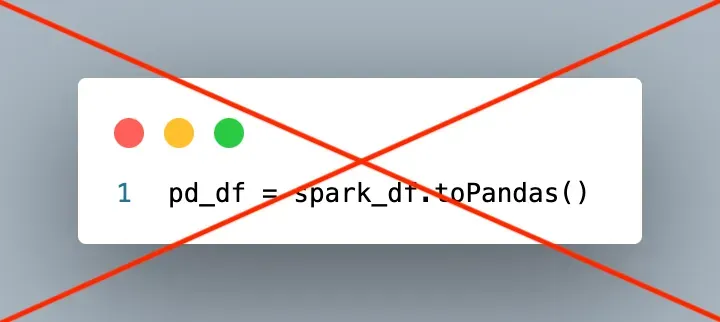
Here’s a bold statement: I never use Pandas for data transformation in Databricks.
Why? Because it’s a misuse of the platform’s power. Databricks is built around Spark which is excels at distributed processing at scale, and Pandas… well, it’s not.
Here’s what happens when you rely on Pandas:
- Memory issues: Pandas processes data in-memory. If your dataset exceeds your driver’s capacity, you’re stuck with crashes or out-of-memory errors.
- Single-node bottleneck: Pandas runs on a single machine, which defeats the whole purpose of using Databricks’ distributed Spark engine.
- Inefficiency: Every Pandas operation is a missed opportunity to leverage Spark’s optimized, scalable transformations.
I’ve seen teams waste hours debugging Pandas-related performance issues in Databricks, only to rewrite the entire workflow using PySpark later. That’s time you can’t get back.
Databricks + PySpark gives you scalability, resilience, and seamless integration with other tools. Pandas? It’s great for quick, local prototyping — but not in a platform designed to handle big data.
The rule is simple: If you’re on Databricks, use Spark for transformations. Pandas is fine for your local environment with small data and data exploration.